Jasm technical overview
Copyright Jasm
Technology 2019-2026. All rights reserved.
admin
(at) Jasm Tech (dot) com
 |
Back to home page |
Jasm (noun):
Take thunder & lightning, a steamship & a buzz-saw;
mix them together, and put them in a woman. “She has jasm”.
The term originated in 1842. Synonyms: Spirit, energy,
spunk, zest.
Introduction
I have made
a career-long project of finding the best tools, structures,
and practices for preventing bugs and making code easier to
understand. Making a language designed for this simplifies
things greatly.
We write
computer programs by typing text into an editor and trying to
imagine what it will do. It is hard to program this way, and
it is easy to make errors. This next generation language
describes a better way.
The need for
this product is great. The largest and most complex structures
ever built by man are all software. Anything that makes big
software easier to write and understand will generate
tremendous savings.
The details
of the language are about implementing best practices
automatically and making the programmers job easier. The
language is a vehicle for doing that in a way that is easy to
write, read, and understand.
What is Jasm
Jasm is a proposed
general-purpose programming language based on these
principles:
Simplicity: Simplicity means easy to learn, easy to
read, easy to program, easy to debug, and less complex.
Integrity: High integrity languages prevent bugs by
performing data checks and disallowing dangerous practices.
Multitasking: Jasm simplifies multitasking &
distributed programming.
Graphical
IDE: Visualization tools and a graphical IDE
make the programmers job easier (the Jasm Studio). You never
edit a text file.
Powerful: Jasm has powerful high-level objects and
operations.
Portable: Maximum portability.
Productivity: The end goal is more code done better in
less time.
It does not
look like any existing programming language, but all of the
parts are well known and understood. Jasm is easy to
understand.
Jasm invents
some new things out of necessity, but mostly it combines
existing concepts in new ways to do things better. That makes
it easier to adopt.
Programmers
want a language like the ones they already use, but better,
gets it done twice as fast, and makes their lives easier. That
is Jasm in a nutshell.
Jasm will
allow large project completion in half the time of a
hypothetical average language.
Jasm falls into these categories
- General purpose workhorse
- Procedural
- Object oriented
- Compiled
- Memory safe
- Explicit
- Strongly typed
- Concurrent
- High-integrity
- Uses a bytecode engine or transpiles to C++
or C#
- Both imperative and functional
- Off-side (indentation, not curly-braces)
- Big endian / Big Indian / Network order
The key is simplicity
- Easy to read & understand
- Low learning effort
- Easy to use
- Easy to maintain
- Makes best practices natural (a key design goal)
- Reduces software complexity
- Jasm is a low complexity language
- Hides all pointers and memory management;
implements these in the simplest possible way.
- Low frustration (You should not have to stop programming to
figure out how to do something, what this line of code does,
or why it is doing that)
- Creates the boiler-plate for you (20-50% of the code is boiler-plate in most
programming languages)
- Native support for security, distributed
processing, and massive data sets
- Collapse/expand views hide unimportant
details
- Doesn’t give the programmer any
hand-grenades. Simple, safe, easy-to-use methods replace all
dangerous practices.
- Your time is worth more than a few bytes
- It is OK to have only one way to do
something, as long as it is a good way
- Attention to the little details that
prevent bugs and make your job easier
Creating simplicity is not
simple, it has been my life’s work.
High-integrity saves you debugging
Programmers
spend more than half their time debugging, anything that
reduces that is a big time-saver.
Jasm uses
strictness, checking, and other high-integrity techniques
because human error always happens.
High-integrity
languages ensure that data will always be within range.
More than
50% of common bugs will not happen with Jasm, and more than
80% of the serious bugs will also be prevented.
High-integrity
languages reduce the cost of development by 50% because there
are 70% fewer fixes and 90% fewer bugs seen by the customer.
The most common bugs
- Procedure arguments not checked (Jasm
checks the arguments for you).
- Boiler-plate errors (Jasm handles the
boiler-plate for you)
- Syntax errors not caught (Jasm catches
them)
- Errors handed incorrectly (Jasm has good
error handling & messages)
- Test cases not keeping up with code changes
(Jasm shows test coverage and lack thereof graphically)
- Flow control errors (Jasm prevents a lot of
these with errors & warnings)
- Bad math (Sorry, Jasm can’t fix your math)
The most difficult types of
bugs to solve
- Pointer problems (Jasm does not have
pointers)
- Memory deallocation problems (Jasm handles
all memory allocation and deallocation for you)
- Access to memory that is no longer valid
(Jasm prevents this)
- Buffer overruns (Jasm prevents this)
- Wrong order-of-initialization (Jasm
separates construction from initialization and helps prevent
order-of-initialization problems)
- Race conditions (Provides multitasking
tools to help with this)
These can cause project-killing
quagmires.
Other bug prevention
- Language design that makes best practices
natural & automatic
- Language design produces simpler code
- High level objects and the ability to use
validated 3rd-party libraries result in less code
- A lot of time has gone into the little
details that prevent bugs and make the programmers life
easier.
Designed for debug
Programmers spend half their time debugging;
yet no language has been designed for debug before.
Most languages can debug, but you have to
write code in special ways to do it effectively. Jasm does
this for you.
Multi-tasking done right
The four
types of multi-tasking are single-threaded, multi-threaded,
multi-process, and distributed. Each is different from the
other.
Jasm
provides a seamless multitasking interface to all four, so the
same code can run single-threaded, or use any type of
multi-tasking in a blocking or non-blocking way.
Remote
interfaces (TCP/IP, VXI, etc) of every type are virtualized, so your code
handles all of them without any changes.
All of this
is done in a simple and straightforward way.
Graphical IDE
A graphical Integrated
Development Environment is something new, only one other
language has it.
- Handles the usual IDE operations like
editing, compiling, LINTing,
debugging, threading, reformatting, boiler-plating, help,
etc.
- Collapses details you don’t care about
right now, and expands them when you want them.
- You never have to edit text files; the IDE
creates and hides all the boiler-plate (unless you want to
look at it or debug through it).
- Some things are simpler and look better if
viewed in a graphical way (see code examples below).
- The IDE handles transforming your code into
modules, units (opaque modules with an
interface), pre-compiled libraries, applications,
projects, and so forth.
- Visualization tools are built into the IDE
to help make sense of complex projects.
- The IDE hyperlinks everything for
navigation and information.
- Handles important details like help,
cleanup, metrics, spell-checking, language localization,
over-compression/decompression, etc.
- The files are still easily readable in a 3rd
party text editor.
Powerful
Provides
high-level productivity-increasing commands and objects.
Half of the
programming languages do not implement enumerations, and those
that do implement them incompletely. Enumerations must be
partially or completely hand-coded in all other languages.
No
programming language implements symbol lists, state machines,
binary search trees, language localization, or relational file
managers. They must be hand-coded.
Jasm
implements all of these things, and allows them to be extended
to reduce program complexity.
Portable
The compiler & tools will be
written in C++ for performance and portability. With two easy
ports it will run on Windows, Linux/Unix, and Mac. This covers
most compile platforms in use today.
Output can be set to one of
several standard byte-code engines or transpilers.
This will allow execution just about everywhere.
Productivity
- Cuts development time in half by reducing
bug rates and creating boiler-plate code automatically.
- Eliminates 80% of the worst types of bugs
and prevents project-killing bug quagmires.
- This is the first language designed for
debugging. Programmers spend more than half their time
debugging.
- Programs are easier to understand.
Languages with similarities
- Eiffel is the most similar language. It is a
high-integrity multi-tasking language with a graphical IDE.
Eiffel is not used much because it is expensive
($10,000/seat), complex, and the programmer must learn to
think in the Eiffel way.
The free version of Eiffel is crippleware. Jasm is better because it is much
simpler, easier to learn, and we plan that it will be less
expensive.
- Ada is a high-integrity multi-tasking
language. It is not used much because the core language,
though well-designed, is old and archaic. It has been kept
up to date, but updates were design-by-committee. It is also
complex. Ada is a niche language used in defense work. Jasm is better because it is
simpler, more powerful, and better integrated.
- HAL/S is an archaic high-integrity language. It
was quite readable compared to other languages of its day.
HAL/S was used in aerospace. Jasm is better because it is
a modern multitasking language.
- C# has safety and multitasking built in, but
at the cost of great complexity. When looking for a better
programming language I was attracted to what C# can do until
I saw the 527-page spec and said “I don’t want to learn
this”. Jasm is
better because it is much simpler and easier to learn.
Also, C# only gives safety to those who know what to do
and not do.
- Go has simplicity and multitasking, but does
not significantly reduce bug rates. Jasm is
better because it reduces bug rates.
- Java is highly portable and prevents the worst
bugs, but does not prevent most bugs. It also needs a lot of
boilerplate. Jasm is better because it
prevents common bugs and handles all the boilerplate.
- Rust prevents the worst bugs, but does not
prevent most bugs. It is also hard to learn. Jasm is
better because it is easier to learn and prevents common
bugs.
- Kotlin prevents the worst bugs, but does not
prevent most bugs. Jasm is better because it
prevents common bugs.
- V (aka VLANG) is
comparable to the Jasm minimum viable product. Jasm is better because it goes far beyond
what VLANG does.
No other language has the
combination of simplicity and bug prevention that Jasm does.
These things reduce development time and cost significantly.
What about functional programming?
Jasm has a
functional programming mode. Use it whenever possible. You can
cut back and forth between functional and imperative
programming.
Jasm makes
functional code easy to write & understand, and allows it
to be used in most types of programming; This alone is worth
making a new language.
What about purely functional languages?
FP uses a
different programming paradigm. FP is simple, good at
multitasking, and prevents most bugs. It’s great if you can
use it. Unfortunately, pure FP has these limitations:
- Pure FP programs are very difficult to
design, read, and understand for those who are not practiced
in the art. The learning curve is steep.
- It is not good for I/O, so not a good
choice for programs that do a lot of it.
- It needs a lot of memory and CPU speed, so
is not a good choice for systems that are limited in these
areas.
- It doesn’t do state well, so is not a good
choice for programs that are fundamentally state machines.
I have been
programming for over 40 years and did many types of
programming. Every project I have been on did lots of I/O, had
to fit into available memory, and was fundamentally a state
machine. Functional programming has never been an option. This
is largely why only one functional language has caught on, and
only in its niche.
The best way
to make money in pure FP seems to be to teach it; the ratio of
jobs to practitioners is not good.
What about reactive programming?
Jasm has native support for
reactive programming.
What about AI?
Jasm will benefit from artificial
intelligence more than any other language.
- The big picture: Modern AI is the latest
development said to make programmers obsolete. None of the
preceding disruptive technologies replaced programmers;
instead, they allowed programmers to write more and larger
programs. AI will likely do the same (Jevon’s paradox). Jasm
is designed for medium and large programs; with AI the world
will need Jasm even more.
- AI and no-code solutions promise to let you
build applications much faster. In reality, they make easy
things easier and hard things harder. Jasm makes hard things
easier. They are complimentary.
- AI generates 40% more bugs. Jasm mitigates
this by preventing bugs and because it is designed for
debugging.
- Jasm gets the same benefits from AI as any
other language.
- Jasm’s syntax and structure allows
AI-enabled programming better than most other languages.
- It will be easier to read & understand
AI-generated Jasm code. This is a significant advantage.
- We can support AI-enabled debugging, which
does not have a lot of attention at this time.
- Jasm Studio is an integrated software
development suite. We have a list of ways AI can assist and
accelerate software development by cross-connecting separate
Jasm tools at a very low level. No other language can do
this, and it allows Jasm programmers greater AI
acceleration.
Pick one thing
If we had to
pick only one thing to do well, it should be making a large
multitasking/distributed application. Whatever the future of
programming brings, it will probably be heavily parallel
and/or distributed. Jasm pays a lot of attention to this
target.
Syntax summary
- Standard imperative programming language
syntax. Most programmers will immediately recognize it, read
it, and be able to come up to speed using it quickly.
- Standard object-oriented programming
syntax.
- Attributes are declaration suffixes that
modify the behavior of language elements. For example, the noret attribute tells Jasm that using the return
value from your procedure is optional, and not to remind you
if you don’t use the return value from that procedure.
- Directives provide compiler instructions.
For example, #charsize allows
you to declare ASCII or UNICODE text.
- Pragmas are special comments that control
error message output and Jasm tools. For example, align-comma pragmas line up the commas of your data
into neat columns to make it easier to read.
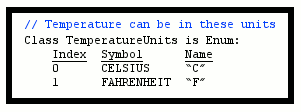
Example definition file (temperature.jd)
- A definition file is a true header file.
- Comments
are blue.
- Keywords
are bold.
- Many things are simplified, like creating
an enumeration by using the “create enum” tool; it creates a
powerful object that can be derived from and extended.
- Because the procedure in this example takes
an enum argument, it can handle
data in 5 formats: “Celsius”, TemperatureUnits.CELSIUS,
0,
“0”,
or an enum instance. Everything
gets handled for you.
- e means it
returns a standard error.
- The red argument
is a reference that returns a value
//
Water temperature may only be 0 to 100C
typedef float as water_temperature_in_c( 0.0 to 100.0 )